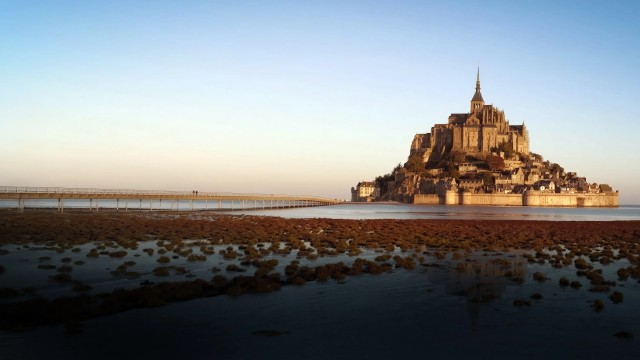
Im Nordwesten Frankreichs, wo Bretagne und Normandie aufeinandertreffen, erhebt sich ein weltberühmtes Wahrzeichen: die Abtei Mont-Saint-Michel. Doch nicht nur Touristen fühlen sich angezogen. Die Bucht beherbergt eine vielfältige Tierwelt. Hier liegt auch die größte von Tieren geschaffene Konstruktion Europas: das Saint-Anne-Riff. Erbaut von Trichterwürmern, die erst erscheinen, wenn die Flut ihre Wohnröhren überspült. Und an der rauen Felsküste der Bretagne lebt ein echter Held, der Schleimfisch. Als aufopferungsvoller "Super-Papa" bewacht er die Eier mehrerer Weibchen.
Tra maree che sfiorano escursioni di 14 metri e onde impetuose, il Mont-Saint-Michel emerge come un'icona selvaggia tra Normandia e Bretagna. In questa baia estrema, piccoli animali e creature sorprendenti sfidano correnti e tempeste, trasformando la costa francese in uno spettacolo naturale unico e affascinante.
In the northwest of France, where Normandy meets Brittany, rises one of the world’s most iconic landmarks: Mont-Saint-Michel. This impressive monastery, perched on a rocky island surrounded by tidal flats, is among the most visited sites in Europe. Equally spectacular is the surrounding bay, an extreme habitat shaped by tides that can rise and fall by up to 14 meters. This magical landscape is home to a fascinating array of wildlife, perfectly adapted to the rhythm of the sea. Among its wonders is the largest animal-built structure in Europe: the Saint Anne Reef, created and inhabited by thousands of tube worms. The film also explores the dramatic coastline of Brittany, where powerful currents and massive waves force animals to develop extraordinary adaptations. Here, fatherly blennies become heroes, snails master the art of "parallel parking," and hundreds of thousands of creatures share a single "building." In many ways, France’s wild coastline is a record-breaking natural world.
Dans le nord-ouest de la France, à la frontière entre la Normandie et la Bretagne, se dresse un monument mondialement connu : le Mont-Saint-Michel. Ce monastère imposant, situé sur une île au milieu des marais salants, est l’une des attractions les plus visitées d’Europe. La baie qui l’entoure est tout aussi spectaculaire : avec une amplitude de marée pouvant atteindre 14 mètres, elle offre un habitat extrême pour une faune fascinante. Parfaitement adaptée au rythme des marées, cette région a même donné naissance à la plus grande construction animale d’Europe : le récif de Saint-Anne, édifié et habité par des vers tubicoles. Le film nous plonge dans cette baie célèbre ainsi que dans la côte dramatique de la Bretagne, où les courants puissants et les vagues gigantesques obligent les animaux à développer des adaptations étonnantes.